
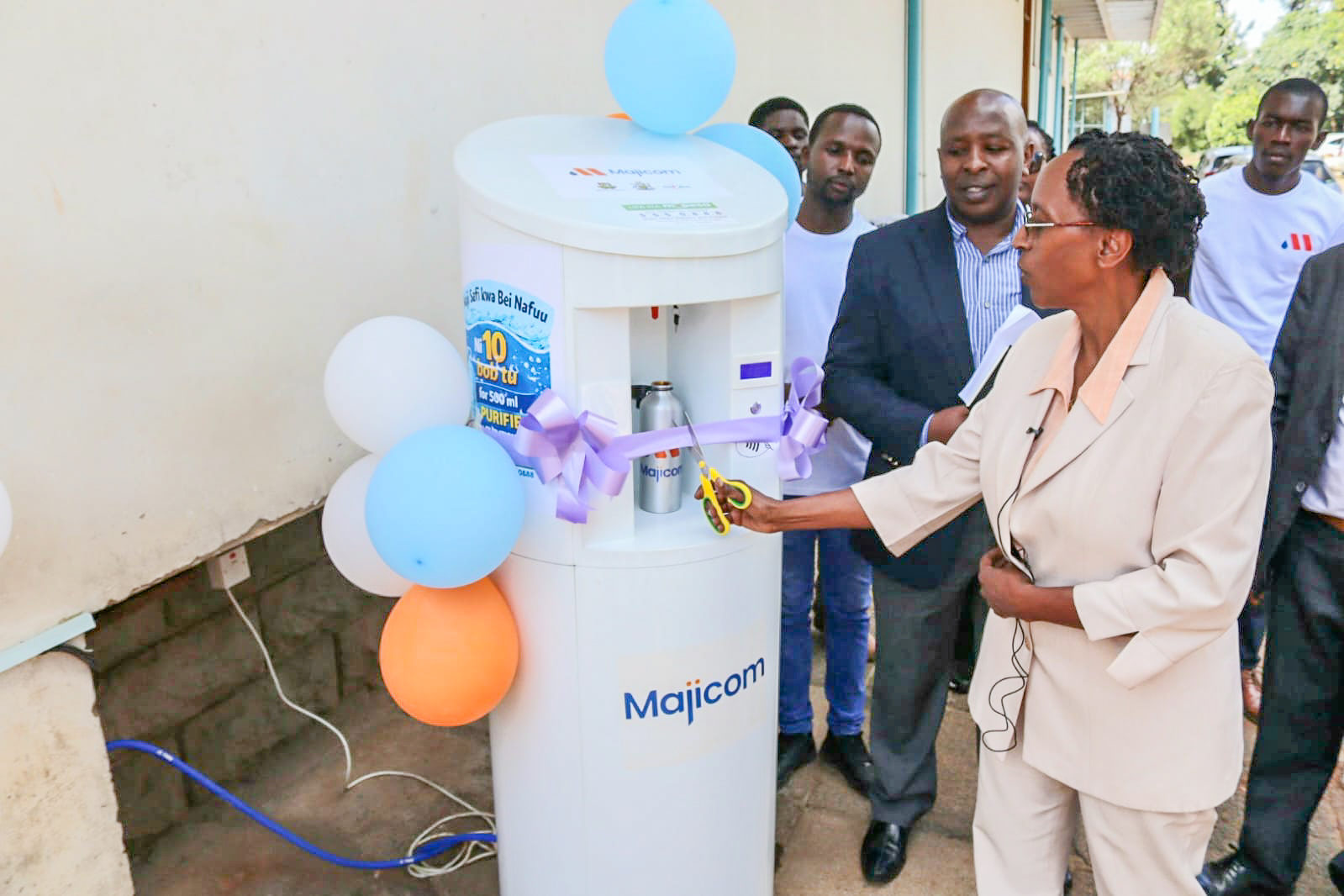
The Faculty of Engineering launched a smart water purification kiosk on campus on Thursday, March 12, 2026, making clean filtered water available to the university community at five shillings per 250ml refill, payable via M-Pesa. The unit, developed in partnership with UK-based Majicom Limited, will run on a three-month trial period before a wider assessment is made.
The launch brought together university leadership, faculty, departmental chairs, Quality Assurance and the Majicom team. Dean of the Faculty of Engineering Prof. Siphila Mumenya read the remarks of Vice-Chancellor Prof. Jesang Hutchinson, while Prof. Maina Wagacha, Director of Intellectual Property Management, represented the Deputy Vice-Chancellor for Research, Innovation and Enterprise. Jonathan Wolf, Head of Production at Majicom Limited, represented the industry partner on the day.
In her remarks, Vice-Chancellor Prof. Hutchinson described the kiosk as more than a piece of infrastructure. She said it would serve as a demonstration facility and a research platform where students and researchers could engage directly with the technology, test improvements, and explore further applications. "This water purification kiosk symbolizes the power of university-industry collaboration where research, engineering expertise, and innovation come together to develop sustainable solutions for communities," she said.
Prof. Wagacha characterized the installation as a living laboratory, pointing to the involvement of students and interns in the development process as evidence of a meaningful shift toward research that solves real problems. "Through such initiatives, our students gain exposure to real-life engineering challenges, helping them develop the skills required to solve complex problems in society," he said.
Majicom's Jonathan Wolf outlined the technology behind the unit. The kiosk runs a smart computer management system that monitors chlorine content and water levels remotely in real time. It is equipped with advanced filtration technology and a self-cleaning mechanism, reducing the need for on-site maintenance. The unit is portable and currently connected to mains power, but has been fitted with an internal battery and successfully tested for solar energy compatibility, keeping the option of off-grid deployment firmly on the table.
Users are required to bring their own bottles, a deliberate design decision that eliminates single-use plastic waste at the point of consumption. At five shillings per 250ml, the kiosk delivers clean water at roughly one-third of the cost of supermarket bottled water. Volume purchased increases in five-shilling increments, keeping the pricing model simple and accessible.
The Faculty of Engineering has committed to a three-month evaluation of the kiosk's performance. The trial will inform decisions on scaling the technology and on the research outputs the project can generate for the university and for communities beyond the campus.
- Log in to post comments


