
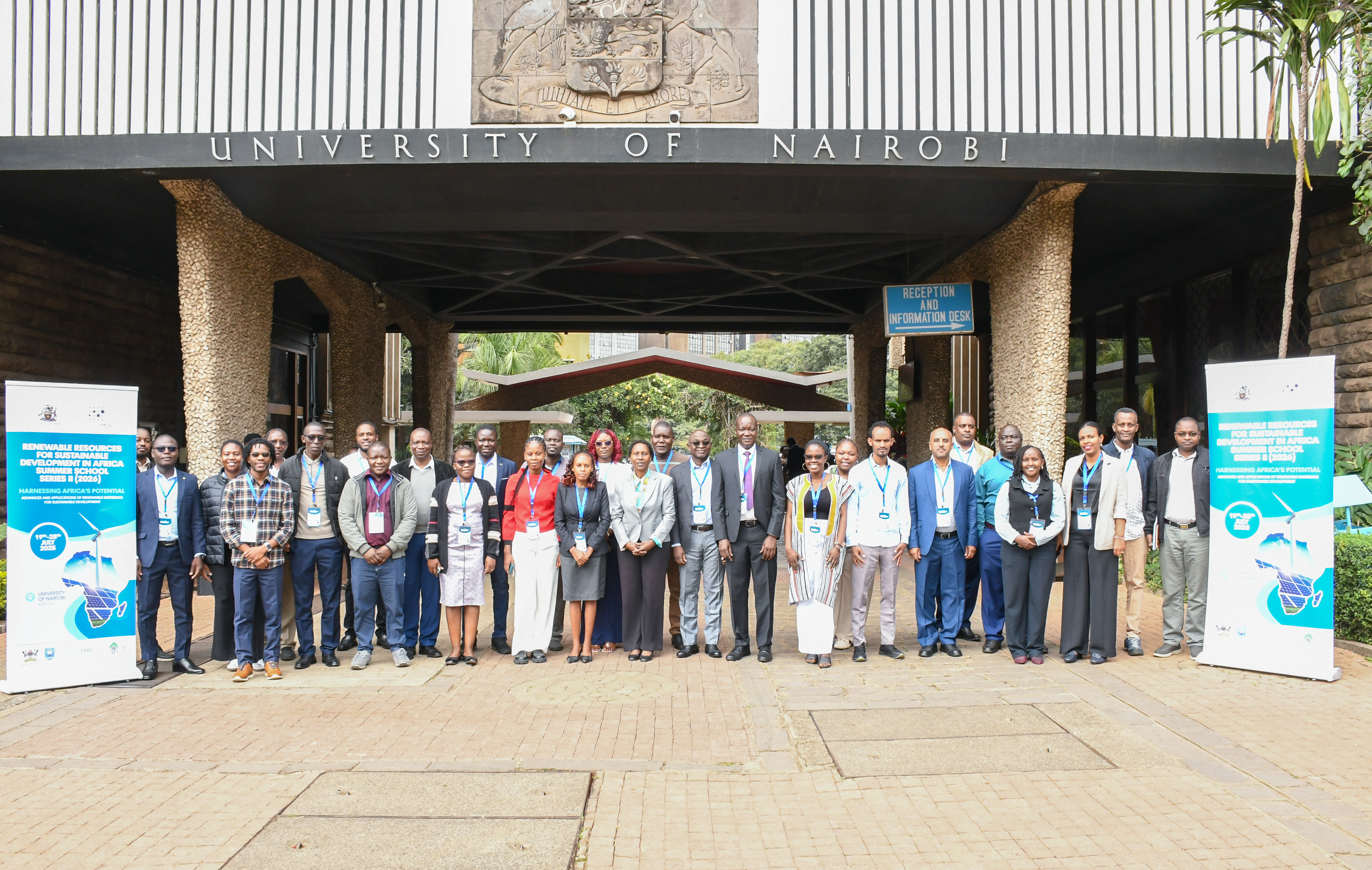
The second edition of the International Summer School on Smart Green Infrastructure officially commenced on Monday, July 20, 2026, bringing together 25 early-career researchers from African countries for an intensive 10-day programme focused on renewable energy, climate-resilient agriculture, and sustainable infrastructure. Funded by VolkswagenStiftung, the programme brings together 25 PhD candidates and postdoctoral fellows, reflecting its commitment to nurturing the next generation of African researchers and innovators. Building on the success of its inaugural edition hosted by Makerere University, Uganda, in 2025, this year's Summer School continues to strengthen regional collaboration, capacity building, and knowledge exchange in advancing smart and sustainable solutions for Africa's development.
The opening ceremony was officiated by Eng. Prof. Siphila Wanjiku Mumenya, Dean of the Faculty of Engineering, who welcomed participants to the University of Nairobi and underscored the critical role of engineering and innovation in addressing Africa's sustainability challenges. In her remarks, Prof. Mumenya highlighted the Faculty's commitment to nurturing the next generation of researchers and innovators capable of developing scalable and sustainable solutions to climate change, energy access, and food security challenges across the continent. She noted that the Summer School provides a unique platform for interdisciplinary learning, mentorship, and collaboration among emerging scholars from diverse academic and cultural backgrounds.
The programme is co-led by Co-Principal Investigators Prof. Duncan Mbuge of the University of Nairobi, Assoc. Prof. Peter Wilberforce Olupot and Assoc. Prof. Michael Lubwama of Makerere University, Uganda, Prof. Yetenayet Bekele Tola of Jimma University, Ethiopia, and Prof. Kouassi Dongo of Université Félix Houphouët-Boigny (UFHB), Côte d'Ivoire. Bringing together expertise in renewable energy, sustainable infrastructure, climate-resilient technologies, and agricultural engineering, the Co-Principal Investigators are fostering interdisciplinary learning, regional collaboration, and knowledge exchange to equip emerging researchers with the skills needed to advance smart and sustainable solutions for Africa.
Drawing on their extensive expertise in sustainable energy systems, engineering materials, and climate-resilient technologies, the project leaders are spearheading the programme's multidisciplinary approach to advancing smart green infrastructure while fostering research collaboration, knowledge exchange, and capacity building among emerging African researchers.
Throughout the programme, participants will undertake intensive interdisciplinary training across nine thematic areas, including solar, hydro, geothermal and wind energy systems, bioenergy and biogas technologies, life cycle assessment, smart irrigation and digital water management, climate-resilient agricultural mechanisation, post-harvest technologies, and green infrastructure policy and financing.
To enrich the participants' practical learning experience, the programme includes a field excursion to a geothermal power installation in Kenya, providing first-hand exposure to one of Africa's leading renewable energy infrastructures and offering valuable insights into the technical, environmental, and policy dimensions of sustainable energy systems.
Representing Cameroon, Côte d'Ivoire, Nigeria, Somalia, South Africa, Ghana, Mozambique, Benin, Rwanda, Togo, Tanzania, Ethiopia, Uganda, and Zimbabwe, the participants embody the programme's pan-African vision of knowledge exchange and capacity building. The Summer School continues to strengthen regional partnerships in engineering, sustainability, and innovation while fostering the knowledge, skills, and collaborations needed to advance smart green infrastructure development across Africa.
- Log in to post comments


